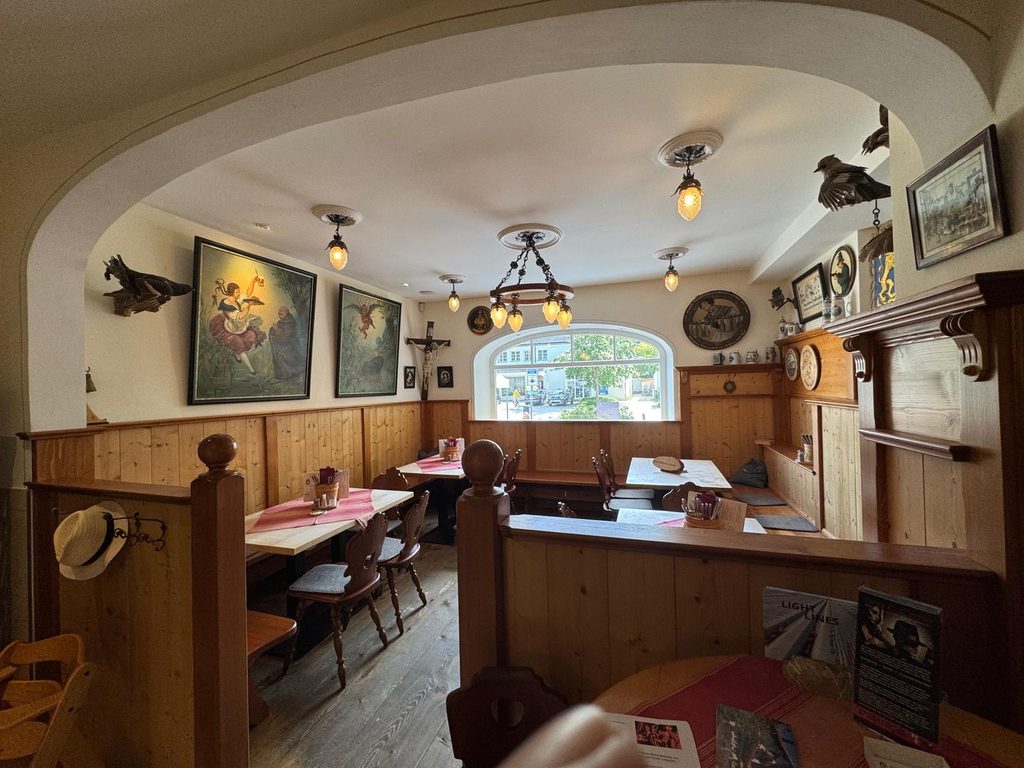
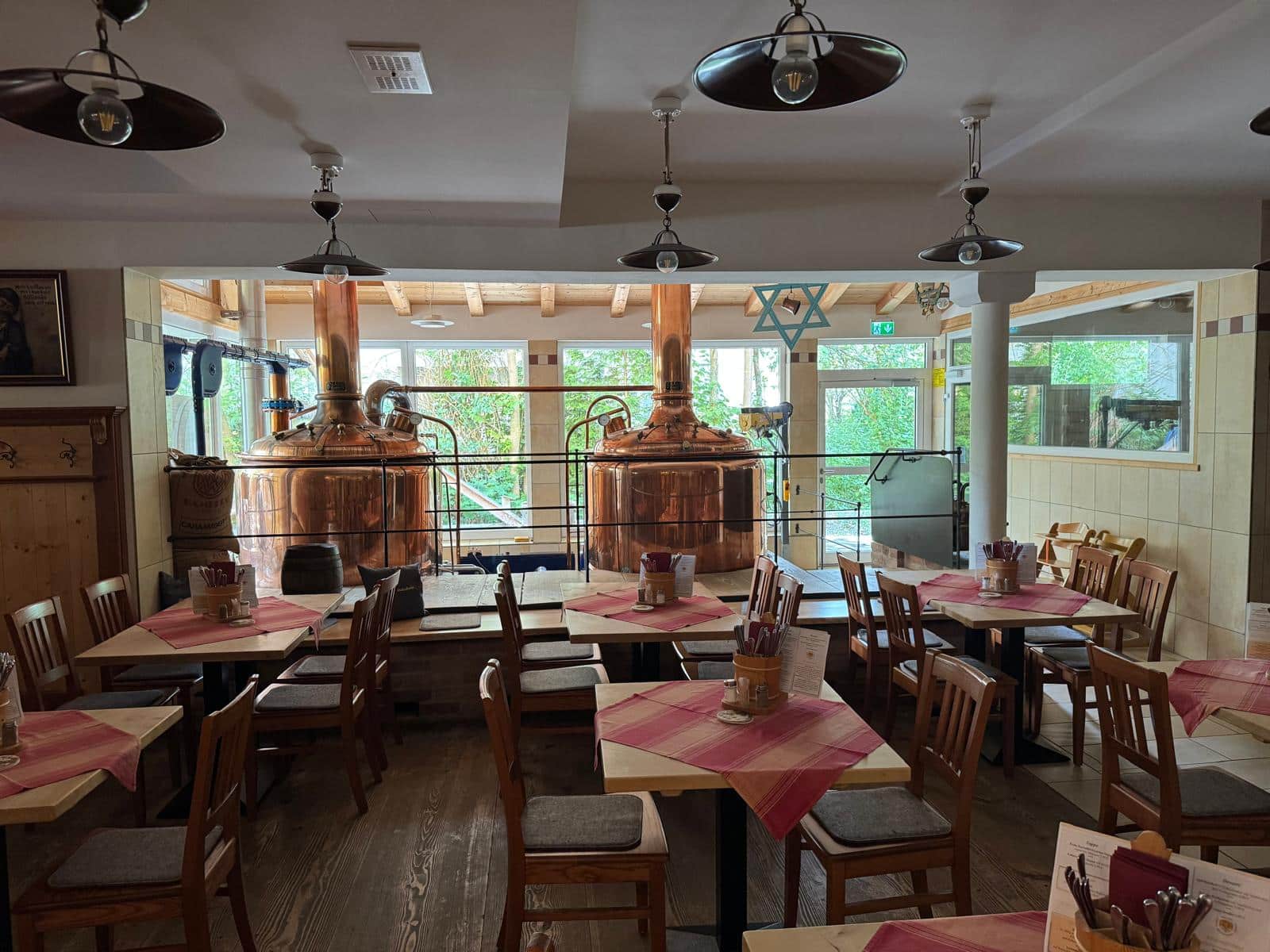
When we’ve been chilling in the Kurpark for a bit or attended an event at the Kurhaus, we quite like to end up at the Tölzer Binderbräu afterwards. Sometimes just for a beer, sometimes we stay on for dinner. The nice thing about it: it’s only a stone’s throw from the Kurpark – and once you’re inside, you’re practically standing right in the middle of the brewery.
I’ll admit: when it comes to beer, I’m actually more Team Tegernseer. But the Tölzer beer tastes good too! And somehow even a bit better when you’re sitting right next to it and know it was brewed just a few metres away in those big copper kettles.
But the Binderbräu isn’t just interesting because of its beer. If you look around the inn a bit more closely, you’ll discover a surprising amount of Tölz history.
When Tölz still smelled of beer
Bad Tölz used to be a proper beer town. In the 18th and 19th centuries, there were at times 22 breweries. Beer barrels were even transported on rafts down the Isar to Munich, while beer carts rumbled through Marktstraße.
Many of the old breweries eventually disappeared. Their names have partly survived to this day on buildings and in the town’s history. The Binderbräu consciously connects to this old Tölz brewing tradition.
The irony is that the Binderbräu itself is still pretty young.
From “Haus an der Sonne” to brewery
The building on Ludwigstraße, on the other hand, has long been part of Tölz’s spa district.
In the past, it was known among other things as “Café Carlo” and later as “Haus an der Sonne”. The house, which is over 100 years old, was a spa guesthouse, pastry shop and café; most recently it housed a Greek restaurant. At the end of 2012, Monika Weber-Binder and Andreas Binder bought the property.
During the renovation, old wallpaper and rose patterns from the time of previous owners even came to light. Nine large containers of materials and rubbish were removed from the building before it could become today’s brewery and folk art house.
On 16 December 2015, the Binderbräu finally opened its doors. Initially rather quietly – but just a few days later, the inn was so full that guests had to be turned away.
The brewery stands in the middle of the inn
And that’s the detail we particularly like about the Binderbräu.
The beer doesn’t disappear somewhere behind a wall or in a hall on the edge of town. The copper brewhouse stands right in the middle of the dining room. That’s where the Helles, Dunkles and Weißbier are brewed today.
You sit at your table with your meal or your beer and have the big gleaming copper kettles right in front of you. A beer can hardly be more regional than that.
Maybe that’s why I like it too, even though my personal house brand of beer otherwise comes from a certain other brewery at the Tegernsee.
A former museum director becomes an innkeeper
Why there’s so much to discover at the Binderbräu has to do with Andreas Binder. He used to be director of the Tölz town museum and didn’t want to just set up any old Bavarian inn.
His idea was a brewery and folk art house: brewery, inn and museum under one roof. According to the Binderbräu, the museum is still being developed.
But the inn itself already tells plenty of stories.
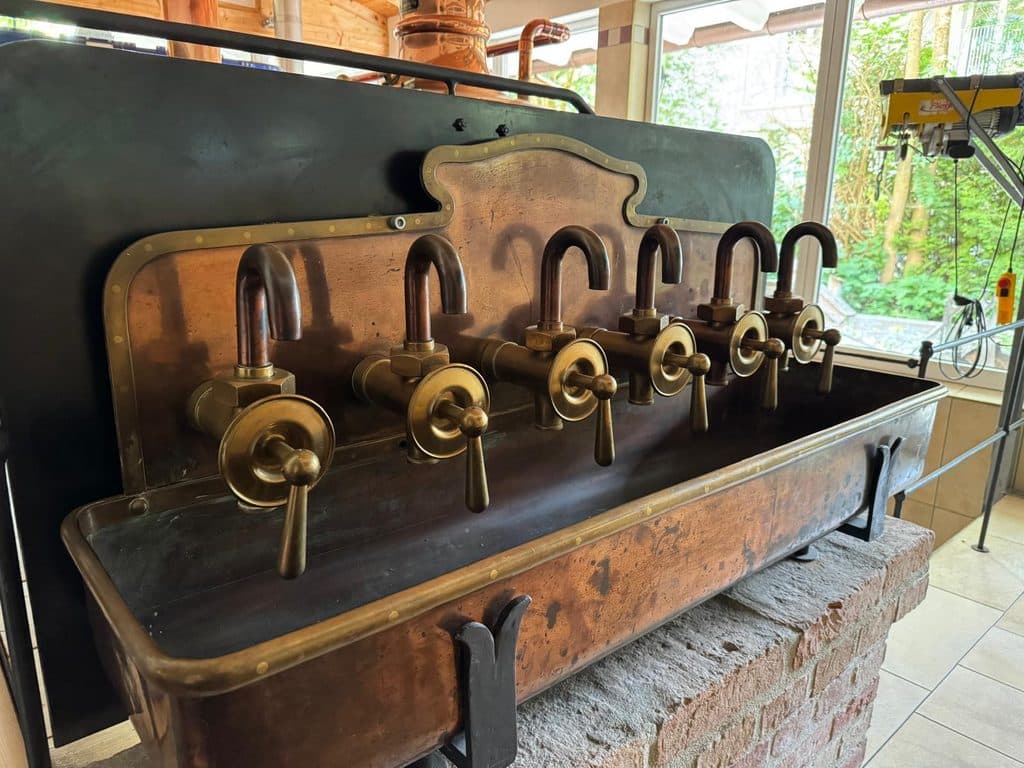
Many objects aren’t decoration trimmed to look old. A historic lauter grant made of copper and brass, for example, comes from the former Grünerbräu. Old lamps are said to have hung in the Grüner-Bräustüberl around 100 years ago. Other historical pieces were collected over the years or rescued from being scrapped.
This way, a relatively young inn is gradually becoming a little bit of old Tölz again, piece by piece.
Thomas Mann sits at the table, in a manner of speaking
The individual rooms also bear names with Tölz connections: Gambrinusstube, Flößer-Salettl, Zur schönen Tölzerin, Stammtisch zur Coletta – and there’s even a Thomas Mann Salon.
Thomas Mann famously had a special relationship with Bad Tölz. At the beginning of the 20th century, he even had a country house built here and spent several summers and winters in Tölz with his family.
And apparently the future Nobel Prize winner in literature wasn’t averse to an evening Helles. It’s documented that he liked to drink a glass of beer with dinner and described its effect in rather literary terms as “Abruhe, Abspannung und Lehnstuhlbehagen” (repose, relaxation and armchair comfort). A lovely phrase.
And actually quite an apt description for a cosy evening at the Binder.
Your own beer mug goes in the safe
Another special feature is also discovered fairly quickly in the inn: the hand-forged Stammkrug safes. Regular guests can lock their personal beer mug in there. There’s even a dedicated “Brunnengrand” for washing out the mugs. When the Binderbräu opened, the first 48 spaces in these mug safes were taken within no time at all. You can hardly get more Bavarian inn culture than that.
And what does a wooden dove have to do with beer?
One of our favourite stories about the Binderbräu actually has nothing to do with beer at all.
The family owned an old wooden dove from the 19th century with a pointed iron beak. For a long time, no one really knew what the strange thing had once been used for. Andreas Binder did some research – and came across an almost forgotten historical inn game: Taubenschießen (dove shooting). Don’t worry: no real doves are shot at.
The heavy wooden dove hangs like a large pendulum on a long chain. It’s set in motion and is supposed to hit a target as accurately as possible with its iron beak. The Tölz smoking club “Gemütlichkeit” eventually had such a setup installed at the Binderbräu. The tradition actually lives on.
At the Tölzer Bierfest, Taubenschießen is back on the programme. There are also brewery tours at the Binderbräu, Frühschoppen and the Tölz town championship in Schafkopfen.
A beer festival right on the doorstep
The Binderbräu is a perfect fit for the Tölzer Bierfest anyway, because Vichyplatz is right in front of the building. When the various regional breweries come together there in September, it somehow comes full circle: in a town where 22 breweries once produced beer, Tölz and Upper Bavarian brewing culture is being celebrated together again. And if you want to know how the beer is made, you can even get a behind-the-scenes look at the Binderbräu.
Our verdict
For us, the Binderbräu is above all one of those uncomplicated places. Stroll through the Kurpark a bit, attend an event at the Kurhaus – and then just a few metres further for a beer or dinner. Of course you could just order your food, drink your beer and leave again.
But it’s worth taking a closer look around the Binderbräu. Because between the copper kettles, old lamps, Stammkrugs and historical pictures, there’s a surprising amount of Tölz history.
And then you sit there with a freshly tapped Binder Hell in front of you and know: this was actually brewed right here. Okay, I wouldn’t renounce my Tegernseer because of it. But at the Binder, it’s quite alright to have a Tölzer for once.