
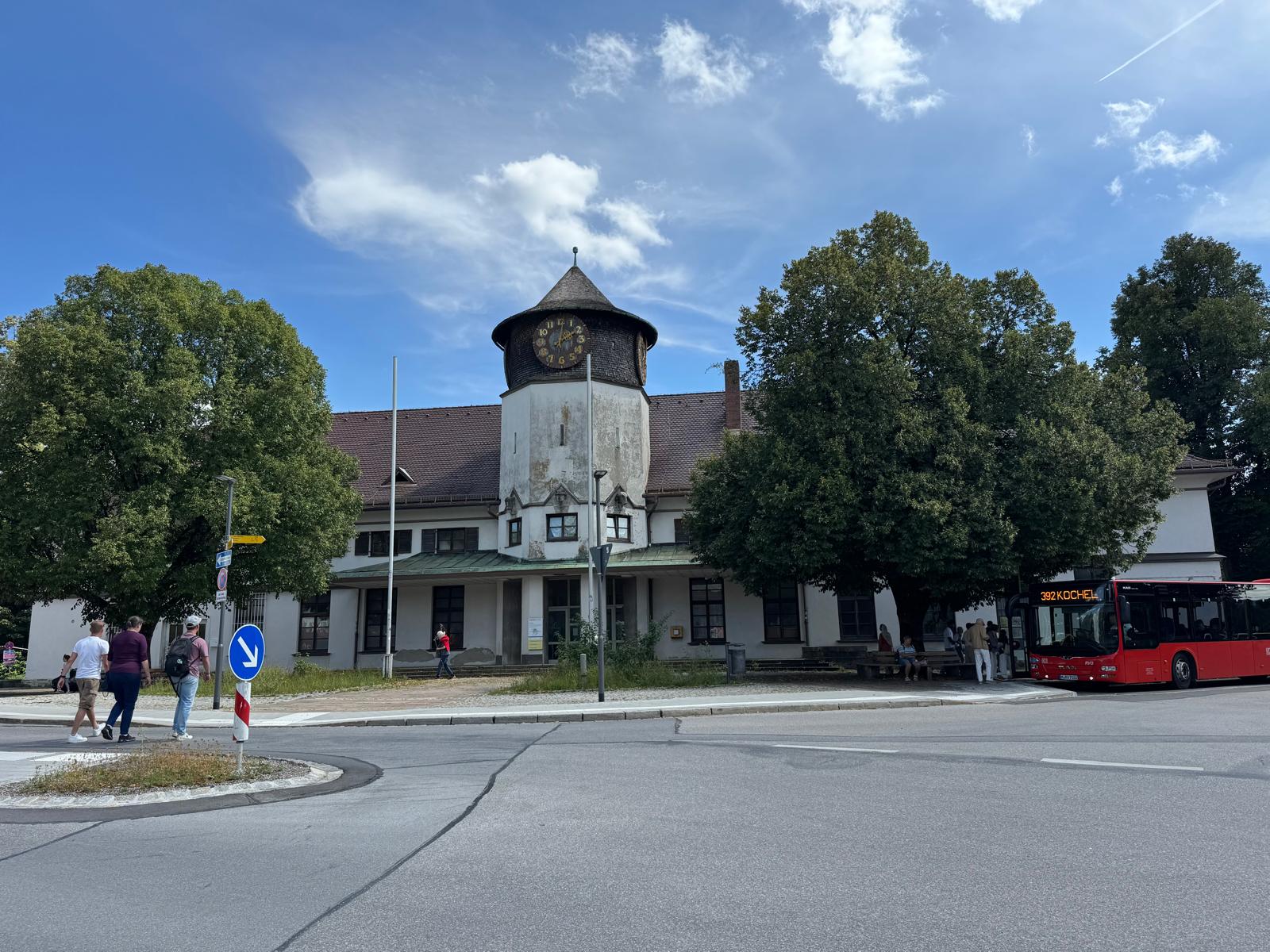
Anyone arriving in Bad Tölz by train gets a rather peculiar first impression of our town. There stands a listed building over 100 years old with a hipped roof, clock tower and actually quite beautiful architecture – looking as though someone at some point simply decided to abandon it to its fate. Of course, we don’t just know the station from passing by. We pick up visitors there, catch the train ourselves now and then, deliberately leaving the car or Vespa at home. And every time you think the same thing: What a lovely entrée to Bad Tölz this could be. Instead, the station has been quite a sorry sight for years. This is particularly annoying because this is precisely where countless holidaymakers and day-trippers arrive every year. Marktstraße, the Isar, Kalvarienberg, the spa quarter – all of that lies ahead of them. But their first impression of Tölz is a run-down station building. Yet its history once began quite ambitiously.
The first Tölz station was in a completely different location
Bad Tölz got its railway connection in 1874. The station at the time was much closer to today’s town centre, roughly in the area of today’s “Alter Bahnhof”. It was a terminus: the line from Holzkirchen initially ended in Tölz. The railway connection changed the town considerably. Suddenly visitors could travel comfortably from Munich, and the railway became enormously important especially for the emerging spa business. Thousands of guests now came to Tölz by train every year. How significant the railway was back then is shown by a wonderful little story: the Tölz magistrate is said to have commissioned a clockmaker to set the town parish church clock a little fast. That way travellers would think it was later than it actually was – and reach their train a few minutes early rather than risk missing it. Whether today’s commuters would still be pleased about that given some train delays is debatable.
Thomas Mann also knew this old station. When he came to Tölz regularly with his family in the early 20th century and later owned his country house here, his train journeys still ended there. His daughter Monika later recalled the slow journey to Tölz and how the familiar landscape drew ever closer. The first station, however, only lasted around 50 years. The reason was the extension of the line to Lenggries – and that in turn had to do with a completely different means of transport: the raft.
Because the Isar lacked water, Lenggries got its railway
With the construction of the Walchensee power station from 1918 onwards, water was diverted from the Isar system. This had consequences for traditional rafting in the Isarwinkel. As compensation, the Bavarian Landtag decided to extend the railway from Tölz to Lenggries. The old Tölz terminus was wholly unsuitable for this. A through station with more space was needed. The then still largely undeveloped rear Mühlfeld was chosen as the location – and many people in Tölz were not at all pleased about that. In 1921 there were protest meetings. Citizens gathered in the Bruckbräusaal to mobilise against the relocation. Their concern was quite understandable: shops and businesses had established themselves around the existing station. A new station far out in the Mühlfeld meant a complete shift in passenger flows. The people of Tölz even passed a resolution against the new building. The transport ministry, however, was not impressed. The station was relocated.
From today’s perspective there’s a certain irony in that: just over 100 years ago, many people in Tölz didn’t want this station at all. Today quite a few would probably wish that someone would finally take proper care of it.
A station on a forest of concrete piles
The construction itself was anything but simple. The ground in the Mühlfeld was swampy and not very load-bearing. Therefore the new station had to be founded on numerous concrete piles. Basically the building stands on an artificial forest beneath the ground. The story gets even more curious when it comes to groundwater. During construction work a water diviner is even said to have been consulted to better assess the water conditions. Whether he actually found the crucial solution is hard to judge today. But we like the idea: a prestigious modern station from the 1920s – designed by architects and engineers – and somewhere someone is walking across the building site with a divining rod.
On 3 September 1924, the new Tölz station was opened together with the line to Lenggries. Bavaria’s Minister President Heinrich Held travelled to the celebration. A decorated special train brought the guests of honour to Bad Tölz and then on to Lenggries. The new station building was designed to be appropriately prestigious. The Munich architect Georg Buchner designed a broad building with a hipped roof and striking clock tower – quite fitting for an aspiring spa town that was welcoming ever more guests by train. Today the building is listed. When you stand in front of it, you understand why. Beneath all the traces of past decades there’s still a really beautiful building. You just need to bring a bit of imagination.
The station building became a problem case
At some point the decline began. Deutsche Bahn sold the station building in the early 2000s. Since then it has been in private ownership and for many years has only been used very limitedly. More than a decade ago there was already discussion about its poor condition. This became particularly clear when the then Bayerische Oberlandbahn withdrew its customer centre from the building. At the time there was talk of broken heating, mould, crumbling plaster and musty smells. Ticket sales eventually moved into containers on the other side of the tracks. Just imagine that: a listed historic station building stands there – and the railway operations prefer to move into a container. A building can hardly say more clearly that something is going wrong.
And that’s exactly what annoys us. This isn’t some faceless functional building in an industrial estate somewhere. The station has a clock tower, a large hipped roof, historic proportions and a location that could make it a proper gateway to Bad Tölz. You’d just have to imagine what it could become: a decent waiting room, café or small restaurant, perhaps tourist information, a nice area for arriving and waiting – and above or beside it uses that would make renovation economically viable too. Other towns would be glad if they still had such a historic station building. We have one. We just let it look rather sad.
And the town can’t simply get started
It’s not quite as simple as “Well then the town should just renovate it”. The building doesn’t belong to the town of Bad Tölz, but to a private owner. This limits what the municipality can do. According to public statements, the town has tried to acquire it in the past. No agreement has been reached so far. At the same time, listed building protection, fire safety, structural issues, possible uses and of course considerable renovation costs all play a role. All of that explains why a solution is difficult. But at some point it no longer explains why one hasn’t been found for decades. While all around bus stops are being rebuilt, paths made more accessible and public transport modernised, in the middle of it all stands this historic building looking like a remnant that nobody really wants to touch.
Perhaps this bothers us so much because we regularly experience the station from both perspectives. When we travel by train ourselves, our journey begins there. When visitors come, we pick them up there. And when you’re meeting someone who’s perhaps seeing Bad Tölz for the first time, the condition of the building is all the more striking. Every year people arrive here by train to spend a lovely day or their holiday in Bad Tölz. Many only know the town beforehand from pictures: Marktstraße, Lüftlmalerei, the Isar, mountains, Kalvarienberg. And then they get off and the first thing they see is this station. It just doesn’t fit together.
A hundred years later, people are arguing about this station again
Perhaps the craziest thing about its history is that the station caused controversy even when it was being built. Back then many citizens wanted to prevent it being built. Today many citizens would probably like to prevent it deteriorating further. In between lie more than 100 years of Tölz history. The old terminus has long since disappeared. The “new” station from 1924 is now itself a monument. It has seen spa guests, day-trippers, commuters, schoolchildren and generations of Tölz residents come and go. Really this building deserves something better.
And it’s here, after all these years, that one may speak more plainly: ownership doesn’t just create obligations on paper. A listed station at one of the most important arrival points in a tourist town is not just any property whose condition is nobody’s business. Of course renovation requires money. Of course there’s listed building protection, fire safety, technical difficulties and economic interests. But when owners, town, heritage authorities and potential funders still can’t agree on a way forward after decades, then at some point everyone involved should ask themselves what actually still needs to happen. Because at some point “it’s complicated” stops being a particularly convincing explanation.
The Tölz station could be once again what it was built to be: a beautiful gateway to the town. At the moment it’s more like a business card you’d rather not hand to your guests. After more than 100 years it really would be time to change that.